Back to blog
OCCASIONAL POSTINGS World | US News & Politics | Sports | Book Reviews | Where am I?
|
Sunday, November 9, 10:55 pm
The News in Turkey
*** The residents of the village of Çavuştepe, in the eastern province of Van, Turkey, have sacrificed 44 sheep in honor of Barack Obama becoming the forty-fourth president of the United States.
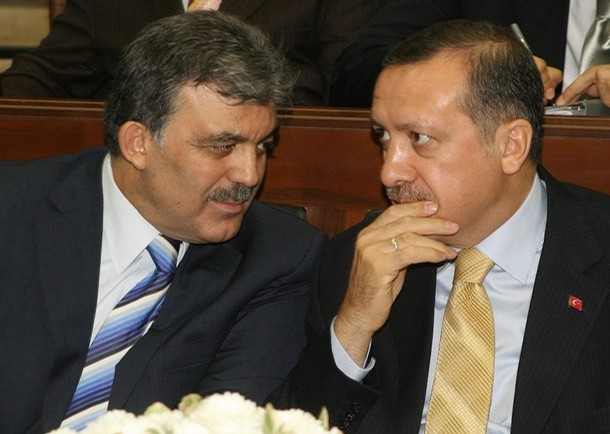
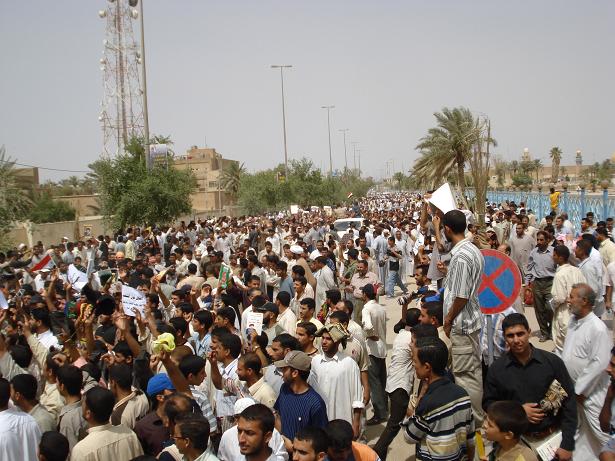
*** Hürriyet reports (in Turkish) that group of several thousand Alevis took to the streets of Ankara on Sunday in protest against the AK (Justice and Development) Party of Prime Minister Tayyıp Erdoğan and President Abdullah Gül. The Alevis, who comprise perhaps as much as 20% of Turkey's population, are Shiite Muslims who have traditionally had a reputation for being strong supporters of the Republican People's Party, currently in opposition. Photos of the protest can be seen here.
*** Sex workers in Turkey are seeking to establish a union. Prostitution is legal in Turkey, although only a small percentage of sex workers officially register with government offices as required. The goal of the union is to help make work conditions safer for prostitutes.
*** A police station in Hakkari, on the border with Iraq, was attacked yesterday by PKK guerillas coming over the border from Iraq. Turkish military helicopters pursued the guerillas into Iraqi territory.
Sunday, November 9, 2:04 am
Film Review: "Mustafa"
Earlier this week I went to see "Mustafa," Can Dündar's controversial new documentary about Mustafa Kemal Atatürk, the founder of modern Turkey.
I have always considered Dündar a rather bland figure, well-known for his vaguely liberal left-of-center and very uncontroversial views. Dündar is a newspaper columnist who has written a number of books on contemporary affairs, but he'd always struck me as someone who was more interested in asking questions than in staking out an opinion. Fifteen years ago he came out with an earlier documentary of Atatürk which I have never seen, but which was tame enough to have served as standard fare for Turkish elementary school classrooms every since. It was therefore surprising to hear that many people had found his latest endeavor insulting to Atatürk, even in a country where hagiography often passes for history when it comes to Turkey's first president.
I found the first half of 'Mustafa' much less interesting than the second. Indeed, Dündar is mainly concerned with the Turkish War of Independence and subsequent years, so the parts of the film detailing Mustafa Kemal's childhood and early career offer little excitement. Indeed, Dündar seems to be in a bit of a hurry to get on to the War of Independence, skipping over major events like the Unionist takeover in 1908 and Kemal's activities in Libya. There is, in fact, much about Kemal's life during these years that I think audiences would find interesting, but Dündar doesn't stray far from the general outlines of Kemal's life that are already of general knowledge in Turkey. As a result, the film feels like it is simply going through the motions at this stage while Dündar looks ahead to the second half of the film.
The second half of 'Mustafa' is indeed much more interesting, and is controversial because these parts of the movie depict Atatürk in ways that Turkish audiences are not used to seeing. Dündar is careful here, and much of the film's narration does not extend beyond reading quotations from Atatürk's notebooks and proclamations and reciting facts that are undisputably true yet frequently ignored. When it comes to Atatürk, though, even this relatively low-key approach is enough to unsettle some people. At one point, for example, a discussion of Atatürk's jailing of political opponents is followed by the observation that "now, in Turkey, there would be no opposition party, there would only be one party," as ominous music is played in the background and viewers are shown a succession of imperious-looking statues of Atatürk of the sort that exist everywhere in Turkey today. No one, of course, can really contradict this charge, but often the lack of an opposition party in for most of Atatürk's tenure as president is portrayed as evidence of the universal support Atatürk is supposed to have enjoyed during these years. For people who have grown up learning this version of history in school, Dündar's film can be quite jarring.
It seemed to me that the aspects of Atatürk's life that Dündar really wanted to engage were from the War of Independence onwards, and this part of the documentary exudes an energy that was missing earlier on.
'Mustafa's soundtrack is by Goran Bregovic, which I found a lot more suitable for the earlier parts of the film than the latter ones. After all, Mustafa Kemal was born in the Balkans (Thessaloniki), so Bregovic's Balkan tunes fit in well with the mood and the scenery of Kemal's early days. As the film proceeds, however, this music becomes a little more distracting. Why are we listening to Balkan music as we watch Atatürk in Istanbul or Ankara in the 1920s and 1930s? I guess Dündar wanted to suggest that, at heart, Atatürk remained a lad from the Balkans. Nevertheless, it seemed to me that a more diverse soundtrack--perhaps employing some Münir Nurettin Selçuk for the Istanbul scenes in the early republic--would have worked a bit better at this point.
When the film was over, the (Turkish) friends that I had seen 'Mustafa' with were visibly upset. They didn't disagree with the veracity of what was said, but questioned Dundar's motives in focusing on 'negative' aspects of Atatürk's life. "Atatürk looked like a dictator," said one friend, while others were bothered by a scene in which he had appeared rather callous in describing the attachment to Islam of the soldiers he had commanded in the War of Independence. My friends felt that Dündar had ignored Atatürk's positive contributions while selectively using unflattering and unrepresentative samples from his diaries in an effort to make Atatürk look bad.
Frankly, I don't think 'Mustafa' is a movie that anyone outside of Turkey would consider controversial. But for a movie like this to be shown in theatres in this country is, I think, quite noteworthy, given the way in which his reputation has been idealized for so long in this country.
Indeed, even discussing Atatürk as a human being can be difficult in this country, for the man is so usually presented mainly as a set of principles used to justify the existing political order of Turkey. And it is precisely because 'Mustafa' manages to humanize its subject somewhat that the film is worth seeing. While it would have been nice if more had been done to illustrate the social and intellectual milieux from which a person like Mustafa Kemal could emerge, I think 'Mustafa' not only provides a basis for discussing Atatürk's legacy in somewhat less idealized fashion, but it also makes it easier for an individual living in the early twenty-first century to connect with the man on a more personal level.
If I ever have the opportunity to teach a class on modern Turkish history, I would love to be able to show a subtitled version of this film to my students. Not only is the film itself enlightening, but the very fact that it would be made and the reaction it has received can tell us something about what's going on in Turkey today.
Tuesday, October 28, 1:49 pm
Turkey: Proxy Battles
Blogspot, the popular blog-hosting service, has been banned in Turkey. This is one of more than 1000 websites which cannot be accessed in Turkey, including YouTube. People accessing these sites get a message telling them that access to the site has been blocked by the Telecommunications Ministry. Most of the sites are blocked because they contain content which has been deemed insulting to Atatürk or to 'Turkishness.'
There are ways around the bans--anyone who is the slightest bit web savvy seems to know about the numerous proxies which can be used to access the sites. Surely the Turkish government knows about these proxies as well, yet the blocking of websites continues unabated.
For the state, it's of course a hopeless struggle to stop these websites, but I think it is felt that appearance need to be kept up. The Turkish state--the permanent establishment which exists no matter which political party is in charge--is simply unable to climb down from its Kemalist and statist worldview. Allowing YouTube, which includes postings that are meant to be insulting to Atatürk, to be accessed without proxy would constitute an admission that the state cannot, and has no right to, control people's access to information in Turkey. And the prospect of the state no longer being able to demand this control, more than the websites themselves, is what is seen as truly threatening.
In many ways, the proxy server can be seen as analagous to the way in which many taboo issues are brought up in Turkey. In the 1980s, for example, Prime Minister Turgut Özal did a lot to get people talking about issues like the Kurds, the place of Islam in Turkey, and the role of the military in society by indirect means. He talked, for example, about how is mother was a Kurd at a time when many people in Turkey denied the very existence of Kurds as a separate ethnic group. He took the Prime Minister's limousine to Friday prayers when such a public display of piety had previously been unthinkable for a Turkish Prime Minister. He played an important role in the political rehabilitation of Adnan Menderes, which contributed to the emergence of debates relating to the proper role of the military in Turkish politics.
A lot of people dislike Özal, and the many was certainly corrupt, but I think that he also did a lot to open up conversations that needed to--and still need to--be had. But rather than take on these subjects directly--and invite repurcussions from those who would feel threatened by their discussion--Özal's method was to provoke discussion through symbolic gestures. In so doing, he contributed to the emergence of a limited freedom to discuss certain taboo issues which had been largely absent in the 1970s and completely non-existent in the wake of the military takeover of September 12, 1980.
And so today people access prohibited websites by proxy. Nobody really seems interested in doing much to forcefully challenge the state's right to control the internet, yet people find a way around such restrictions anyway. On the one hand, I find this representative of a spirit of compromise--or at least of avoiding direct confrontation--which is in many ways admirable. On the other hand, as was the case with the Özal years, one of the results of this state of affairs is the emergence of a political culture in which new ways of viewing the world exist side-by-side with institutions and practices whose very premises they seem to undermine. Such is the situation in Turkey today, where lively political debate unfolds alongside a statist determination to control the web, where women wear baseball caps in university classrooms because they can't cover their heads Islamically, and where countless other rules which seem impractical are routinely flouted.
These are all proxies, and are all means through which the country continues to change despite the efforts of many people to prevent change. But the tendency for change to come through proxies in Turkey is also an important reason why some institutions in this country appear to have hardly changed at all since the 1920s.
Monday, October 20, 11:36 pm
Ergenekon: Turkey's Troubling Trial of the Century
The so-called 'Trial of the Century' began here today. Eight-six people, including a number of retired generals and prominent journalists, have been accused of plotting to overthrow the government. The undertaking was supposedly called 'Ergenokon.' It is so strange, so sensational, that frankly I have no idea what to believe.
It all started on June 29 of last year, when police raided a home in the Ümraniye district of Istanbul, where they found a stock of weapons. Six months later, in January of 2008, police took thirty-three suspects into custody, claiming they were part of a terrorist group that had been carrying out political assassinations in Turkey, including the January 2007 murder of Hrant Dink, editor of an Armenian-language newspaper in Istanbul. The suspects rounded up included a former Major General by the name of Veli Küçük, a retired army colonel named Fikret Karadağ, a journalist for the newspaper Akşam, Güler Kömürcü, and several other figures. One of the most intriguing names to emerge from the early investigation was Sami Hoştan, who was involved in the Susurluk scandal from the late 90s (more on that below). Police claimed that they had found a so-called 'death list' created by the group which included the names of pro-Kurdish Democratic Society Party (DTP) deputies Ahmet Türk, Leyla Zana, Sebahat Tuncel, Diyarbakır Mayor Osman Baydemir, Nobel Prize-winning author Orhan Pamuk and Zaman newspaper journalist Fehmi Konru. The group, which police claimed was a nationalist death squad with links to the state, was called Ergenekon.
For anyone who has followed Turkish politics over the past fifteen years, all of this immediately reminded us of the Susurluk scandal, which I wrote about when I was living in Turkey back in the nineties. Susurluk had begun in 1996, when a fatal car accident close to the town of Susurluk revealed that a member of parliament, Sedat Bucak, had been riding in a car with Abdullah Çatlı, who had been a right-wing street fighter in the 1970s who was on an Interpol arrest list because of drug-running and weapons charges. Bucak was injured in the crash but Çatlı and his common-law wife were killed. Found at the crash scene were thousands of dollars in cash, numerous weapons and silencers, a cache of heroin, and a number of Turkish diplomatic passports (in fake names and bearing Çatlı's photograph) personally signed by the Turkish Interior Minister, Mehmet Ağar. The alias used in Çatlı's passport was 'Mehmet Ӧzbay," the same one used by Mehmet Ali Ağca, another right-wing murderer from Turkey's bad old days of the 1970s. Ağca is best known as the guy who shot the pope in 1981. In Turkey he is also well known for murdering Abdi İpekçi, a great journalist for the newspaper Milliyet. Ağca later 'escaped' from prison in Turkey, allowing him to return to his job as a free-lance assassin and then later take a shot at the pope under the apparent supervision of the Soviet and Bulgarian intelligence services.
It's all pretty amazing, isn't it? What's more amazing is that no one was ever brought to justice over what clearly seemed to be a case of state support for drug-running and assassination. Sedat Bucak and Mehmet Ağar both had parliamentary immunity, and so were never brought to trial for their actions. It is widely believed that the government was financing assassinations of Kurdish leaders and, possibly, other Turkish citizens. Other allegations included that the government had been involved in assassinating journalists, as well as helping to initiate the left-right violence that plagued Turkey in the 1970s and which served as the pretext for the military takeover of September 12, 1980.
So, on the one hand, the Ergenekon investigation looks promising. After all, it's a good thing to be going after what's called the 'deep state' (derin devlet) in Turkey, the spooky death squads whose existence the Susurluk scandal seemed to confirm. Yet on the other hand, the investigation has taken a strange and troubling turn.
Three days after the police took thirty-three suspects into custody in January of 2008, investigators announced that Ergenekon was not simply a right-wing death squad, but was in fact had been planning to stage a coup in Turkey. In March, police arrested two leaders of the Turkish Workers Party, Doğu Perinçek and Ferit İlsever, a former rector of Istanbul University, Kemal Alemdaroğlu, and one of the best-known journalists in the country, İlhan Selçuk. Selçuk, who is the owner and chief columnist of the venerable daily Cumhuriyet, is one of the fiercest critics of the AK Party government on a newspaper which prides itself on fiercely attacking 'Islamists' wherever it may find them in Turkey. The arrest of Selçuk led to the protest of opposition leader Deniz Baykal, who denounced the way in which the Ergenekon investigation was proceeding.
By Summer, the Ergenekon story was being referred to mainly as a plot against the government. The orginal story--that the 'deep state' had again been exposed in Turkey--was largely forgotten. On July 1, two high-ranking former generals, the Chairman of the Ankara Chamber of Commerce, and the Ankara Bureau chief of Cumhuriyet were taken into custody. One of the generals, Şener Eruygur, had been a major figure in the organization of rallies against the AK Party in the runup to the July, 2007 elections. Eruygur is also the head of the Atatürkist Thought Association--an organization with an Orwellian name but which, up to now, had mainly been known as an informal (and non-violent) branch of the opposition Republican People's Party. Several other members of the association were also arrested at this time. Once again, Deniz Baykal denounced the detentions, and as a result was himself accused of 'acting as the attorney' of the Ergenekon gang. In the days that followed, the investigation reported that coup plotters had planned to set off a bomb in Istanbul's busy Taksim Square in the hopes that it would lead to a military takeover.
Before long, police had found connections between Ergenekon and countless attacks, including the armed attack on the US consulate in July of this year. The former leader of the Kurdish Worker's Party, Abdullah Öcalan, was also reported to have been involved in Ergenekon's activities. On July 28, Cumhuriyet's Selçuk was named by investigators as the civilian wing leader of the Ergenekon conspiracy. On the same day, it was announced that Ergenekon had ties not only with the PKK, but also Hizbullah. Ergenekon, reported investigators, was responsible for planning innumerable acts of terrorism, was the hidden hand behind Turkish-Kurdish conflict, had tried to block the ascension of the AK Party's Abdullah Gül to the presidency, was responsible for the notorious Taksim Square massacre on May Day 1977, and was involved in the murder of Cumhuriyet journalist Uğur Mumcu in 1993.
My apartment in Nişantaşı was broken into in the Spring of 1994. The burglars were never apprehended. Something tells me Ergenekon must have been involved.
What to make of all this? On the one hand, nothing surprises me in Turkey. The existence of secret state-supported death squads in Turkey is not news to anyone who followed Susurluk. On the other hand, much of this seems very strange. İlhan Selçuk working with Hizbullah? Scores of social democratic left-wing republican/secularist Turks conspiring with the PKK to murder prominent left-wing republican/secularist journalists in hopes of...what? Bringing down the government? In 1997, the Turkish military forced Prime Minister Necmettin Erbakan to resign simply by holding a series of press conferences in which the country's leading generals announced that 1) Turkey was a secular country, 2) the Army has a responsibility for maintaining the country's secular character, and 3) the Army believed Erbakan was putting that secular character at risk. Erbakan got the message, and resigned before things got out of hand. The claims of the Ergenekon investigators that a vast conspiracy tried again and again to overthrow the government, without success, therefore strike me as very difficult to believe. And since when do plots to take overthrow the government in Turkey involve journalists and university professors?
Indeed, just as Erbakan's ouster came to be known as the 'soft coup' or 'postmodern coup' in Turkey, during the Summer of this year--at the same time in which the Ergenekon probe was transformed into an investigation into anti-government plotting--the country's Supreme Court was widely expected to hand down a verdict closing the AK Party and banning several dozen of its parliamentarians from politics. I had written about this last June, and felt quite confident that the party would be closed down. It wasn't. In a move that surprised everybody, the Supreme Court ruled that the AK Party only had to pay a fine.
Was the Ergenekon investigation a pre-emptive strike to intimidate those who would shut the AK Party down?
I truly hope that there is some basis to the Ergenekon charges. I really do hope that the AK Party has not somehow managed to hijack an investigation into the deep state and transform it into a witchhunt against its political rivals. But frankly, I find all of this too unbelievable. That a single organization is responsible for seemingly every crime ever committed in Turkey seems preposterous. That a conspiracy of academics, journalists, generals, and right-wing fascists worked together to carry out assassinations of Kurds and republican/secularists strikes me as totally unbelievable.
But like I said, I hope I'm wrong.
I guess we'll find out more as the trial unfolds.
Shaimiev Lives
As I have discussed in earlier posts on this site, rumors regarding the health of Tatarstan president Mintimir Shaimiev constituted the number one topic of local political commentary in Kazan the last couple of weeks I was there. These rumors became only more pronounced after September 21, the date which Shaimiev had been scheduled to return from his vacation in Turkey. Shaimiev made no public appearances after September 21, even as the official press center of the Tatarstan government issued messages on his behalf.
On September 26 Shaimiev suddenly appeared on television, giving an interview to life.ru in which he joked at length about the rumors. No explanation was made for the extension of his holiday, or for why no effort had been made over the previous two weeks to quell the rumors. Two days later, it was announced that Shaimiev had returned to Kazan from his vacation.
Irek Murtazin, the many who first posted the rumors on his blog on September 12, is currently being investigated by the state prosecutor. Murtazin also writes that his wife, a presenter on Vesti-Tatarstan, has been fired from her job in retribution for Murtazin's postings. Murtazin also appears unconvinced that the video of Shaimiev was actually shot at his hotel in Kemer.
Indeed, it is a strange video. Shaimiev is shown in shorts and hawaiian shirt, but none of the people shown walking in the background are dressed in ways one would expect of vacationers in the south of Turkey walking around the grounds of their hotel. Shaimiev also seems uncomfortable, laughing nervously while he fiddles with his sunglasses and frequently looking behind him. Prompted by the interviewer, who tells him that he swims three kilometers a day, Shaimiev talks about how much he loves swimming and the temperature of the water.
Murtazin points out that at one point (0:42) an individual in the background appears to be wearing a white robe, at which point the scene is cut, continuing with a closeup on Shaimiev's face. Later in the interview (1:57) there is a very quick blast of ambulance sirens of the sort that is made when an ambulance approaches the doors of a hospital.
I have no idea what to make of all this. Shaimiev is clearly alive and looks okay, at least healthy enough to conduct a two-minute interview. Nevertheless, the whole episode has been very odd. While I'm sure that my friends in Kazan are delighted to see Shaimiev looking healthy and giving interviews, I don't think this video will entirely douse people's suspicions that something happened to Shaimiev during the course of his Turkish vacation.
Tuesday, September 23, 12:29 pm
Where is Shaimiev?
Rumors regarding the health of Tatarstan president Mintimir Shaimiev have become so widespread that it's hard to believe that anyone in the republic hasn't heard them. On Monday night they were acknowledged on television for what I think was the first time--on the "Gorod" news show of the local channel "Efir." On "Gorod" there was a very short (approximately one minute) discussion of the prosecutor's investigation into Irek Murtazin, who first set off the rumors two Fridays ago. Gorod's report stuck very close to the basics of the case and did not go into the question of whether or not the president is in good health.
Meanwhile, Shaimiev himself has yet to appear on television, despite the fact that he was supposed to have returned from vacation in Turkey yesterday. Given the extent to which the rumors have become a distraction in the republic, Shaimiev's failure to appear publicly seems significant. On Monday afternoon, the official news organization of the Tatarstan government released an announcement by Shaimiev congratulating villagers on this year's agricultural output, but there was no appearance of Shaimiev himself. In the evening, meanwhile, both "Efir" and the Rossiia-Tatarstan channel reported on written proposals sent by Shaimiev to the government but did actually show Shaimiev doing anything. Indeed, neither channel mentioned whether or not Shaimiev had even returned from Turkey.
Shaimiev's failure to materialize on Monday has led to even more speculation regarding the state of his health.
Monday, September 22, 2:36 pm
Two Takes on Iraq
On Sunday, the New York Times ran a large piece by Dexter Filkins called "Back in Iraq, Jarred by the Calm." It's certainly a very positive portrayal of recent events in Iraq. Writes Filkins:
According to Filkins' account, "al Qaeda" has been largely defeated in Iraq, thanks to the US policy of buying off insurgents.
Meanwhile, the following was taken from today's edition of University of Michigan professor Juan Cole's Informed Content:
8 Killed, 82 Wounded in Bombings, Attacks;
Benchmark Laws Still StalledThe guerrilla war continues in Iraq. On Sunday, guerrillas blew up the general manager of the Ministry of Finance, Ihsan Ridha, and a Brigadier General, Adel Abbas, who was a manager of the ministry of the interior (which has FBI-like functions in Iraq). Ridha was injured; Abbas was killed. Police and army patrols were bombed in Baghdad, and police stations were bombed in the major northern cities of Mosul and Kirkuk. One of the police patrols in Baghdad was attacked in the Sunni enclave of al-Adhamiya (the police are mostly Shiites), suggesting that the sectarian war is still going on.
There is no point in targeting high ministry officials and security forces on the ground like that unless you are trying to cause the government to collapse. The pattern of the attacks shows that the guerrillas have by no means given up and that they are still engaged in a concerted and effective attack on the institutions of the Iraqi government.
CNN Arabic says that 8 persons were killed and 82 persons were wounded in these various attacks (see below).
Al-Zaman reports in Arabic that the parliamentary session scheduled for Sunday on the enabling law for provincial elections had to be cancelled because the Arab and Turkmen members of the committee set up to reconcile the wording of the law walked out. Kurdish MP Fu'ad Ma'sum complained bitterly that the walkout was an insult given all the extensive concessions the Kurds have made. Monday is seen as a last chance for parliament to pass the law if the elections are to be held this year.
The law has been held up because parliamentarians cannot agree on how to treat the disputed oil province of Kirkuk.
Al-Zaman also reports that Oil Minister Husain Shahrastani is complaining that the independent deals struck by the Kurdistan Regional Government with a Norwegian firm have impeded the passage in the federal parliament of an oil law.
Al-Zaman says that former interim prime minister Iyad Allawi says he insists that any security agreement between the Bush administration and the al-Maliki government be submitted to 'public opinion' in Iraq (presumably via a national referendum). He added that when he was in Washington 2 months ago he had told the Americans that they had as well give up on getting a bilateral security agreement passed. He also said he was considering pulling his party out of the Iraqi national security council, on which all major parties have seats, since it had utterly failed to deal with Iraq's problems.
McClatchy reports political violence in Iraq on Sunday:'Baghdad
- A bomb was planted under the car of the general manager of the Ministry of Finance, in Kindi street in Harthiya neighborhood on Sunday morning. Ihsan Ridha, the manager was injured in that incident.
- Gunmen assassinated Brigadier General Adel Abass, a manager in the ministry of interior in Adel neighborhood around 7:30 am. He was killed with his driver.
- Gunmen opened fire on an officer in the general inspector office in New Baghdad neighborhood. Raad Amar, the officer, was wounded and he was transferred to hospital to be treated.
- A roadside bomb targeted a police patrol at the Maghrib intersection of Waziriyah in north Baghdad. Five people were injured, including one policeman.
- A roadside bomb targeted an army patrol in Waziriyah neighborhood in northern Baghdad near the Turkish Embassy. Seven people were injured including three soldiers.
- A bomb was planted under a car in Tahriyat intersection in Karrada neighborhood in downtown Baghdad. Four people were wounded, including one policeman.
- A roadside bomb targeted the Bayna newspaper building in Nidhal street(downtown Baghdad). Two people were injured.
- A roadside bomb targeted a police patrol in Zafarniyah neighborhood (east Baghdad). Six people were wounded including three policemen.
- A roadside bomb targeted a police patrol near the in downtown Baghdad. Seven people were wounded, including three policemen.
- Police found three dead bodies in Baghdad neighborhoods today: two were found in Karkh bank; one in Dora and the other was in Amil. While the third one was found in Fudhailiyah on Risafa bank.
Mosul
- A bomb planted under an oil tanker detonated near an army check point in Arabi neighborhood in Mosul city around 3 pm. Two people were wounded including one soldier.
- A suicide truck bomber targeted the emergency police headquarter in New Mosul neighborhood in Mosul city around 6:15 pm. Two policemen were killed and 45 others wounded, including 15 policemen. Also 50 houses got damaged in that explosion.
Kirkuk
- A suicide car bomber targeted a police check point near the fourth bridge in Ghazala neighborhood in downtown Kirkuk. Five policemen were killed and twenty three were wounded.
Salahuddin
- A bomb planted under a parked car detonated near a restaurant in Tikrit. Three people were injured.Goodness-are these two people even writing about the same country?
Filkins also seems to credit the 'surge' with restraining violence in Iraq, and sounds a note of concern regarding the reduction of American troops in the country.
Cole and others, meanwhile, have often argued that the reduction in violence has more to do with the accomplished fact of ethnic cleansing in Iraq, rather than the 'surge.'
Satellite imaging that shows Sunni Arab neighborhoods in Baghdad dark gives evidence that the ethnic cleansing of the Sunnis by Shiite militias accounts for the fall in violence in Baghdad, not the extra troops Bush sent, called the 'surge.'
'Night light in neighborhoods populated primarily by embattled Sunni residents declined dramatically just before the February 2007 surge and never returned, suggesting that ethnic cleansing by rival Shiites may have been largely responsible for the decrease in violence for which the U.S. military has claimed credit, the team reports in a new study based on publicly available satellite imagery. "Essentially, our interpretation is that violence has declined in Baghdad because of intercommunal violence that reached a climax as the surge was beginning," said lead author John Agnew, a UCLA professor of geography and authority on ethnic conflict. "By the launch of the surge, many of the targets of conflict had either been killed or fled the country, and they turned off the lights when they left." The night-light signature in four other large Iraqi cities — Kirkuk, Mosul, Tikrit and Karbala — held steady or increased between the spring of 2006 and the winter of 2007, the UCLA team found. None of these cities were targets of the surge. Baghdad's decreases were centered in the southwestern Sunni strongholds of East and West Rashid, where the light signature dropped 57 percent and 80 percent, respectively, during the same period.'The two also have conflicting opinions on the likelihood of Iraqi refugees returning to their homes. Filkins sounds hopeful, writing that Iraqis "are beginning to return." Cole takes a different tack:
I visited some of these displaced Iraqis in one of the 'some place elses,' i.e. Amman, in August; 50,000 of them are considered 'vulnerable' by the aid agencies and their situation is desperate. Some Iraqis in exile told me that they could never return. They were Sunni and their own neighborhoods were now 100% Shiite. Or their spouse was a Shiite and they were Sunni, and there was no mixed neighborhood left where they would feel comfortable. Some 25% had had a child kidnapped. Many had received personal threats from militias that they are convinced are still in their old neighborhood.(E.g. 'If Ahmad Adib shows his face in this neighborhood again he will be shot on sight .. .') Indeed, sometimes the militias track them down in Amman and threaten them there again. A lot of Iraqis in Jordan move from apartment to apartment frequently so as to avoid the long arm of the militias.Filkins' depiction of how American soldiers interacted with Iraqis also converges sharply with what others are saying. Reporting that he had viewed American marines "walking about without helmets or flak jackets or even guns," he quotes an Iraqi woman who professes to "love" American soldiers.
In the 24 months that her sons were gone, Ms. Salman said she rarely ventured outside. The exception, she said, was when she saw American soldiers.
“Oh, I love them,” Ms. Salman said, brightening in her darkened house. “I always knew I was safe with them.”
The mayor of Baghdad seems to have other views, also reprinted in Informed Content.
Interview with Baghdad Mayor Sabir al-Isawi by Teodor Marjanovic in Prague; date not given: "'I Have Survived Four Assassination Attempts:' Baghdad Mayor Says Americans Are Often Hard To Deal With and Explains What Has Calmed Down Sectarian Killing in His Country"
iDnes.cz
Saturday, September 20, 2008
OSC Translated Excerpt
(Marjanovic) When you look back, do you think that the Iraqis should be grateful to the Americans for something?
(Al-Isawi) Yes and no. As Iraqis, we should feel gratitude that the Americans brought down the hated Saddam regime for us. But -- and I wish to say it very strongly -- so long as the Americans continue to be stuck in their ruts, the last remainder of gratitude will evaporate. They ought to be able to be liberators and not act as occupiers.
(Marjanovic) Be concrete.
(Al-Isawi) During detentions, they do not heed human rights. They carry out raids without reason. They shoot more than necessary. They shrink from quickly determining the exact relations between the two states so that the situation no longer is that one occupies while the other obeys.
(Marjanovic) And how do they complicate the life for you,as the City Hall?
(Al-Isawi) They are driving their heavy vehicles and tanks insensitively, through people's gardens. They crush sidewalks. They demolish lampposts. They are driving, there is a post, but they will not go around it.
(Marjanovic) Can you complain?
(Al-Isawi) Yes, we call them and sometimes they pay for repairs. But this is not just the question of money. One example: it took us six months to build an orchard. Then arrived a tank, and the six months' efforts were destroyed within a moment.
(Marjanovic) But you are aware of the thousands of Americans who perished in Iraq.
(Al-Isawi) Of course, they must not be forgotten.
(Marjanovic) Can you imagine a street or a square in Baghdad being named after George W Bush one day?
(Al-Isawi) No. (passage omitted on Baghdad citizens' daily troubles)
(Description of Source: Prague iDnes.cz in Czech -- Website of best-selling, independent, center-right daily; most popular print source among decisionmakers; URL: http://idnes.czAl-Isawi also disagrees with the view that the 'surge' was primarily responsible for the reduction in violence in Iraq.
(Al-Isawi) There are two reasons. The uprising of the Sunnite tribes against Al-Qa'ida as a result of its unending bomb attacks. Initially, Al-Qa'ida had enjoyed those tribes' support. The other cause is Prime Minister Nuri al-Maliki's resolve with which he crushed the Shiite militias in Basra and Baghdad's Sadr City. Even without the help and, at the beginning, knowledge of the United States.
(Marjanovic) They used to say that Al-Maliki was in cahoots with these militias.
(Al-Isawi) Yes, and he proved that it was not true. The political parties, then, finally began to approach the government. It became evident that the prime minister did not want to have anything in common with these Iran-supported armed groups.
(Marjanovic) Here in the West, the reports go that the crucial role was played by the increase of American soldiers last spring.
(Al-Isawi) This was a partial reason for the calming down. Another such partial reason was that the Iraqi armed forces are now working much better. But the two things I mentioned are certainly the most important.Thursday, September 18, 6:40 pm
More on Shaimiev
Kompromat.ru is reporting that the office of the public prosecutor of Tatarstan has started an investigation into the circulation of rumors that Tatarstan President Mintimir Shaimiev has died. The rumors, which began spreading across the republic last Friday, came in the wake of a posting on the blog of Irek Murtazin, a former press secretary of Shaimiev. The rumors are being blamed for a nearly ten percent fall in the value of the state-held giant Tatneft on the Tatarstan stock exchange. Prosecutor Kafil' Amirov has been quoted by kompromat.ru as saying that:
Murtazin, meanwhile, has not renounced his report, and has raised the possibility that Shaimiev could be ailing in Turkey.
Shaimiev is due to return to Kazan on September 21. He has not been seen or heard on television since Murtazin's original post last week. On Monday, the official information agency of Tatarstan announced that Shaimiev had spoken to Turkish President Abdullah Gul by telephone, inviting Gül to visit Kazan during his visit to Russia later this year.
Saturday, Friday 13, 2008 5:06 pm
Rumors of Shaimiev's Demise
The Russian online journal Novyi Region is reporting that Tatarstan President Mintimer Shaimiev has died, a rumor which has been denied by Shaimiev's press secretary. The source of the rumor is Irek Murtazin, a former press secretary of Shaimiev who currently works at Kazan's International Institute for Humanitarian-Political Research. Murtazin first made the assertion in his blog and then was reported by Novyi Region as saying that he had heard the news from a friend staying in Kemer, Turkey, where Shaimiev has been vacationing with his wife.
So far, the facts seem pretty flimsy and appear to be based mainly upon the arrival of a large group of police officers at the hotel where Shaimiev is staying. Other evidence cited by Murtazin includes "the cancellation of very important meetings, the urgent return of officials from out of town business, and the ordering of urgent charter flights to Turkey." No specifics about these allegations have been mentioned in either Novyi Region's report or in that of newsru.com, another site which has picked up the report.
Nevertheless, the rumors do seem to have traveled fast--a number of my friends here had heard about them.
Nothing about them on the local or national news, though. I've also checked the Turkish press, and have found nothing.
Mintimer Shaimiev is seventy-one years old and is the only president Tatarstan has ever had, having been first elected in 1991. Prior to that he was chairman of the Supreme Soviet of the Tatar Autonomous Republic.
Friday, September 12, 2008, 11:22 am
Recent Events in the Caucasus and Russia's Mini-Republics
The other day in the New York Times Ellen Barry had an article on the separatist movement in Tatarstan. According to Barry, the Russian government's abandonment of a policy of steadfast support for the principle of territorial integrity in the face of separatist movements has already attracted the attention of separatists within Russia.
Well, maybe. Indeed, I pointed out in a posting last month the risk Russia was taking by joining the United States in supporting foreign separatist movements in 'mini Republics,' of which many exist within the Russian Federation. On the other hand, the independence movements in Tatarstan and Bashkortostan (the other republic mentioned in Barry's article) are moribund. In Tatarstan today, 'sovereignty'--the compromise which was hammered out after Tatarstan 'suspended' (in 1998) its earlier declarations of independence--is on the defensive, and even the republic's post-Soviet efforts to elevate the status of the Tatar language have come under recent attack. In both Tatarstan and Bashkortostan, the political leadership is far more concerned with reinstating their status as elected officials (scroll down to 'Debates for returning to elected governors'), which was unilaterally stripped by Vladimir Putin in response to the Beslan massacre of 2004. Today, the presidents of Tatarstan and Bashkortostan (as well as other republic presidents and regional governors) are appointed by Moscow, rather than elected.
It's not for nothing that Kazan has been part of Russia since 1552. The Volga Tatars have always been the Muslim community that Moscow has trusted the most. While there were small separatist movements after the revolutions of 1905 and 1917, Tatars from all walks of life have always worked closely with Moscow. I think it would require a major breakdown in authority in Moscow for such a movement to gain hold in Kazan in the forseeable future.
In the Russian Caucasus, on the other hand, the story might be different. Barry also interviews Charles King, who comments on the implications for Russia's recognition of Abkhaz and South Ossetian independence upon the Circassians.
Indeed, in the Caucasus--where there has been a much shorter, less consistent, and less direct tradition of Russian rule than in the Volga region--the possibility of the South Ossetian example creating difficulties for Moscow in the future is less far-fetched.
Friday, September 12, 12:39 pm
Trouble in Ukraine
Nobody's talking about it in the United States, but a serious political crisis has broken out in Ukraine. Those of you keeping score might remember that in 2004 the American-supported Orange Revolution brought a pro-Western government to power in Kyiv, and since then Ukraine and Georgia have emerged as the two most important allies of the United States among republics of the former Soviet Union which have not already joined NATO.
The crisis has been brought on by a feud between two of America's most important supporters in the country, President Viktor Yushchenko and Prime Minister Yulia Tymoshenko. On Wednesday, Tymoshenko joined forces with Viktor Yanukovich (who was the Moscow-sponsored opponent of Yushchenko in the 2004 elections) in supporting a measure to limit the president's powers. The rumors are now that Tymoshenko and Yanukovich will form a coalition government with Tymoshenko as Prime Minister.
Yushchenko's supporters have accused Tymoshenko of treason and Yushchenko himself has threatened to dissolve parliament and call new elections--a move which seems unlikely given his party's own weak standing in opinion polls.
All of this comes at a time when Washington finds itself in an increasingly defensive position in Eurasia. After the heady days of 2004-2005 and the installation of pro-American governments in Georgia and Ukraine, the Bush administration's goals of incorporating both countries into NATO have already contributed to the partitioning of Georgia and risk creating a similarly volatile situation in Ukraine, where the idea of joining the alliance is anathema to the large Russian-speaking population of the country.
As I argued in a recent posting, the Bush administration's obsession with extending NATO membership to these countries is self-defeating. In Ukraine, the prospect of joinging the EU would be a far less divisive and equally effective means of guaranteeing Ukrainian territorial integrity. Indeed, Washington's current plans of putting Ukraine and Georgia on the fast track to membership in NATO could very well lead to the very breakup of Ukraine that Washington is seeking to avoid by promoting its membership. Particularly in today's heated atmosphere, Russians in Ukraine--particularly in the the Crimea--are simply not going to stand for it.
Tuesday, August 26, 2008, 10:29 pm
More Thoughts on South Ossetia
Well, the big story here is of course Russia's recognition of the independence of South Ossetia and Abkhazia. On Russian state television, the decision is being presented quite clearly as a response to the recognition of Kosova's independence earlier this year by the United States and the European Union. Indeed, an extended excerpt of a speech by Vladimir Putin in Germany last June in reaction to the recognition of Kosova's independence was shown on the news tonight. I'd never seen it, but in it he clearly says that if such rules apply to Kosova, then they can apply to countries all over the world.
Indeed, Russia's recognition today marks a reversal of a policy Russia had followed since the end of the Cold War, in which Moscow steadfastly insisted upon the principle of territorial integrity while the United States and the European Union recognized the independence of one state after another in the Balkans. While Russian support for Belgrade was often presented in the Western media in terms of some kind of mystical Orthodox brotherhood between the two countries, in fact Russia supported Yugoslavia's territorial integrity because the Russian Federation is itself divided into republics and autonomous regions which could likewise break apart--and which appeared to be, for much of the 1990s. Thus, despite the fact that Russia for years supported the breakaway republics in Georgia, it never went as far as to recognize their independence--until now.
But Russia is playing a dangerous game. In adopting the approach of the United States and Europe in recognizing--when it suits their interests--the independence of such 'mini-republics,' Moscow has won a battle. But does the Russian government really want to go down this road? Russia today is far more stable than it was in the 1990s--Chechnya has largely been quieted, and Moscow has reasserted control over republics such as Tatarstan and Bashkortostan. But, in buying into the logic of independence for 'mini-republics,' could the Russian government be creating bigger problems for itself in the future?
For the United States and Europe, meanwhile, I think damage control in Georgia has to be accompanied by a new strategy in Ukraine--where the Republic of the Crimea could emerge as a potentially disastrous flashpoint between Russia and the West in the coming years. In Ukraine, ethnic Russians almost unanimously oppose--often quite passionately--the idea of Ukraine joining NATO. George W. Bush's efforts to extend NATO membership to Ukraine could thus precipitate a real crisis, leading to efforts in the Crimea (where the population is overwhelmingly Russian) to secede from Ukraine and a possible Russian recognition of this independence. No matter what, all talk of Ukraine's entry into NATO has to come to an end.
Indeed, the most obvious lesson to be learned from the events of this month is that the White House's policy of beefing up the Georgian military and encouraging NATO membership has been very counterproductive. Even without Saakashvili's disastrous decision to attack South Ossetia, Georgia's entry into the alliance would have precipitated a crisis with the two breakaway republics, whose governments and populations were steadfastly against taking part in any kind of anti-Russian military alliance.
Entry into the European Union, on the other hand, would have been welcomed by a significant proportion of the populations of both republics. Imagine how things might have worked out if, instead of pursuing NATO memberships and attacking the two republics, Saakashvili had managed to make serious progress towards membership in the European Union. Would South Ossetia and Abkhazia really have continued to prefer independence--as opposed to, say, a high level of autonomy within Georgia--in the face of provisional Georgian membership in the EU?
It's too late for Georgia, but this lesson needs to be applied to Ukraine. If the United States and Europe wish to extend their influence in Ukraine without provoking a showdown in the Crimea, the less risky path would be to quietly accelerate Ukrainian ties to the European Union and to abandon the idea--at least for now--of NATO membership.
Of course, getting the Europeans to agree to this is another question--especially given the generally low level of esteem with which our current president is viewed in influential European capitals. However, the Europeans are also disturbed by what occurred in Georgia this month, and will perhaps be more receptive to suggestions which seem constructive and unlikely to provoke.
But first, it will be necessary for Americans themselves to make a break with the policies which have led us to this situation.
Monday, August 25, 2008, 11:34 pm
The lead story tonight on the news was the decision today by the Russian parliament to recommend to Russian President Medvedev to recognize the independence of South Ossetia and Abkhazia. The presidents of both republics came to Moscow for the vote, which in both cases was unanimous. It won't be long now--the big question is how the US and Georgia will react once Russia officially recognizes their independence.
Monday, August 25, 2008, 11:34 pm
The lead story tonight on the news was the decision today by the Russian parliament to recommend to Russian President Medvedev to recognize the independence of South Ossetia and Abkhazia. The presidents of both republics came to Moscow for the vote, which in both cases was unanimous. It won't be long now--the big question is how the US and Georgia will react once Russia officially recognizes their independence.
Saturday, August 23, 2008, 9:34 pm
Bad Times
On the one hand, things have quieted down in South Ossetia. This is a good sign--especially as I still hope to research in Georgia next month.
On the other hand, things don't look so good for the longer term. As I predicted in an earlier posting, Georgia has emerged as the new rallying cry for American neocons, while Vladimir Putin is slowly being fitted to play the role of the next Adolf Hitler. That role has been vacant ever since we captured and executed Saddam Hussein, who five years ago was being described by the neocons in precisely these terms.
As in the United States, journalists in Russia have been doing their best to stir up public indignation. Tonight on the state-run Rossiia channel there was an hour-long documentary on "Georgian aggression" and the history of "genocide" against the Ossetians. Every three or four minutes, the United States and George W. Bush were invoked in sensationalistic and rather unflattering terms.
According to the New York Times, Russia is paving the way towards recognizing the independence of South Ossetia and Abkhazia. Indeed, on the news two nights ago, a lot of attention was paid to the "declarations of independence" made by leaders of both republics on Friday, even though the two republics had actually declared their independence back in the early 1990s.
Back in the States, McCain crony Lindsey Graham has been ratcheting up the rhetoric against Russia, calling on NATO to "stop war-gaming on tables in Brussels" and begin conducting military exercises in Europe. Like many other Americans beating the war drums against Russia, Graham was brazenly deceitful about the circumstances leading up to the crisis in South Ossetia, which began when Georgian forced launched an unprovoked attack on the breakaway republic, killing hundreds of civilians. "It is clear that the Russians tried to create this provocation," declared Graham, ignoring the fact that the Russian government had consistently supported the status quo, in place since the early 1990s, of de facto (but not de jure) independence for South Ossetia and Abkhazia under Russian protection.
Even more disturbing was Graham's claim that Ukrainian leaders had told him that the Russian government has already issued passports to 75,000 ethnic Russians living in Ukraine. If this is true (it might be), I would be interested to learn how many of those passports had been issued to residents of the Crimea. Indeed, as I wrote about on August 13, the Crimea could end up being a potentially disastrous point of conflict between the United States and Russia.
Indeed, the Crimea was on the Russian news tonight, with state television showing dozens of people waving Russian flags to greet the Russian Black Sea Fleet, which is based in the Crimea until 2017, back to Sevastopol.
I'm not the first person to say this, but I agree with the statement completely: were it not for the fiasco in Iraq, surely the destruction of what were--eight years ago--generally sound relations with Russia would go down as the major foreign policy debacle of the Bush administration.
Then again, there's still time.
Updated: Wednesday, August 13, 1:14 am
South Ossetia and the Fate of the “Mini-Republics"
Something about the recent crisis in South Ossetia that needs to be underscored is the absolute necessity of the next US president coming to some kind of understanding with Russia over the fate of the mini-republics, the “national” republics within states which have been the conflict zone of Eurasian space since the end of the Cold War. Chechnya, the republics of the former Yugoslavia, Nagorno-Karabakh, Abkhazia, and South Ossetia are all examples of such “mini-republics,” regions which had their own state apparati--usually autonomous regions or republics within Yugoslavia or the republics of the former USSR. As I discussed in my post yesterday, the question of when to recognize the independence of mini-republics and when to support the territorial integrity of larger state entities has never been answered consistently. Indeed, after years of insisting upon the sanctity of respecting the territorial integrity of states, Russia has now become more aggressive in defending separatism when it suits its interests. The United States, which for years has supported separatist movements when it felt like it, is now up in arms over Russia's support for South Ossetia.
While all eyes have been on South Ossetia this week, the breakaway region of Georgia may only be a preview to what could be a larger, and far more dangerous, conflict over the Crimea—yet another “national” republic within a larger state. The Autonomous Republic of Crimea is predominantly Russian, living rather grumpily within Ukraine, a country with NATO ambitions. The Crimea, moreover, is home to Russia’s Black Sea Fleet, but only for another nine years. According to the treaty concluded between Russia and Ukraine after the breakup of the Soviet Union, Russia gets to lease its base in Sevastopol only until 2017, at which point it is supposed to revert to Ukraine.
The possible repercussions for the Crimea of the events taking place now in Georgia are hardly lost on the pro-American government in Kiev, which has announced that it might not allow the Russian Black Sea fleet back into the Crimea should they participate in the fighting in Georgia—a declaration which invited a furious response from Moscow. Unlike South Ossetia, which hardly anyone in Russia cared about until last week, people in Russia would love to have their government take a stronger stand on Crimean independence. Indeed, the Crimea is the one part of the former USSR that Russians clearly pine for, often referring to it in conversation as “the south of Russia.” Whereas South Ossetia only became an issue for Russians after the Georgian attack on the region, retaking Crimea would be a popular move in many quarters in Russia even without a Saakashvilian pretext.
It's thus important for both the United States and Russia to start being honest--at least in private--about the opportunism and hypocrisy that has characterized the foreign policies of both countries with respect to mini-republics. In this context, John McCain's bellicose rhetoric--blaming Russia alone for the crisis and placing these events within a broad and simplistic historical sweep--is particularly unhelpful.
Something else that is worth keeping in mind about the mini-republics is that the problem is not simply "nationalism." Indeed, while there has been ethnic conflict in many regions of the Balkans and former Soviet Union over the past twenty years, full-scale war tended to break out only in those regions where a mini-republic was involved. This is because in the mini-republics, you don't simply have nationalism, but also a state apparatus devoted to expanding its autonomy or becoming independent altogether. Thus, rather than simply shrug our shoulders and chalk up the violence to "ancient hatreds," it's necessary to try to be proactive about these conflicts because we can see where they might be heading next.
Tuesday, August 12, 2:41 am
Georgia is not Czechoslovakia
As I predicted in my posting of August 9, the crisis taking place in South Ossetia has prompted much anti-Russian vitriol in the American media. Robert Kagan was especially overheated, invoking Czechoslovakia and the Münich appeasement and comparing Russia to Nazi Germany, with the William Kristol likewise blaming the crisis on "Russian aggression."
John McCain, meanwhile, called on the UN Security Council to take up the question of "Russian aggression."
Americans wishing to spend August vacationing with their families or watching the Olympics may wonder why their newspapers and television screens are filled with images of war in the small country of Georgia. Concerns about what occurs there might seem distant and unrelated to the many other interests America has around the world. And yet Russian aggression against Georgia is both a matter of urgent moral and strategic importance to the United States of America.
But Georgia is not Czechoslovakia, and South Ossetia is not the Sudetenland. Indeed, this crisis began when the Georgian army attacked a largely stable and peaceful region where a clear majority of the population does not want to be part of Georgia. For all the talk about "Russian aggression," this fighting is the result of a calculated decision, made in Tbilisi, to draw international attention to a previously non-violent test of wills that had absolutely no reason to go in this violent direction.
Lost amid all of this hyperventilating about Vladimir Putin being the second coming of Adolf Hitler (and weren't these folks making these same analogies about Saddam Hussein five years ago?) is recognition of the fact that Russia is doing nothing in South Ossetia that the United States hasn't been doing in the Balkans since the early 1990s. Indeed, American calls for the territorial integrity of Georgia signal an interesting change of tune in Washington, which has supported separatist “self-determination” in the former Yugoslavia for more than fifteen years. In 1992, the United States and the European Union recognized Slovenian and Croatian independence from Yugoslavia before Belgrade turned to genocide in its effort to maintain control of its borders. In 2008, the United States supported independence in Kosova, which was part of Serbia. In all of these cases, it was Russia which insisted on the importance of respecting Yugoslavia's territorial integrity, while it was the Americans and Europeans who supported separatism.
Indeed, even in Kazan, Tatarstan, which ten years ago ‘suspended’ its earlier declaration of independence from Russia, the United States for years financed a branch of “Radio Liberty” bearing the highly provocative name of Radio Azatlïk—a term which translates more closely to “freedom” than “liberty,” and which in fact carries connotations in the region of political independence. What if there were a region within the United States which had declared its independence from Washington--how do you think Americans would react to a foreign power setting up a radio station within that region with a name like that? Moreover, all of this occurred while Russia was fighting a war of secession in Chechnya.
The United States has been playing this game for two decades—partly by design, partly in response to events over which we had no control. For whatever reason, however, we’ve placed ourselves in a position where we have very little credibility when it comes to defending the territorial integrity of our allies--or protesting Moscow's actions. And now, in the face of obvious Russian opportunism, Georgia is paying the price.
So what is the reason for America’s support of Georgia’s ‘territorial integrity’ when the United States has consistently supported the independence of separatist governments in Yugoslavia and the former Soviet Union? Oil, of course. The Baku-Ceyhan (“jay-han”) oil pipeline goes through Georgia, since neither Azerbaijan nor Turkey would abide by its passage through Armenia--which is still occupying fifteen percent of Azeri territory. In order to keep the region’s oil from Moscow’s influence, the United States must keep a pro-American government in power in Tbilisi. The US doesn’t care about South Ossetia—the pipeline runs through Georgia proper, not the breakaway republic—but Georgian President Saakashvili is Washington’s man and he’s got Georgian territorial integrity on the brain. No matter what, he knew he could count on American support.
But in attacking a breakaway region whose government's separatist policies reflect the sentiment of people living in the region, Georgia is doing what Serbia did when it attacked Slovenia and Croatia in response to their (US supported) declarations of independence fifteen years ago. Indeed, Georgia is doing what Russia itself has done in Chechnya.
American support for Georgia and Russian support for South Ossetia have nothing to do with morality and everything to do with their geopolitical interests. Georgia has no less right to attempt to defend its national boundaries than any other country, but this is a problem that Saakashvili has gotten himself into by attacking a region which has powerful friends. Russian support for South Ossetia is cynical and opportunistic, but it is a card Moscow is playing only in response to America's nearly identical undertakings--and American support for Kosova in particular.
So what does this mean for the US? Continue to support Georgia diplomatically--but please, let's cut out the over-the-top rhetoric. The last thing this country needs is another president who thinks that posturing with bellicose rhetoric is a suitable substitute for diplomacy. We've had that for the past eight years, and the results have not been particulalry encouraging.
Saturday, August 9, 12:08 pm
Russian media coverage of the fighting in South Ossetia
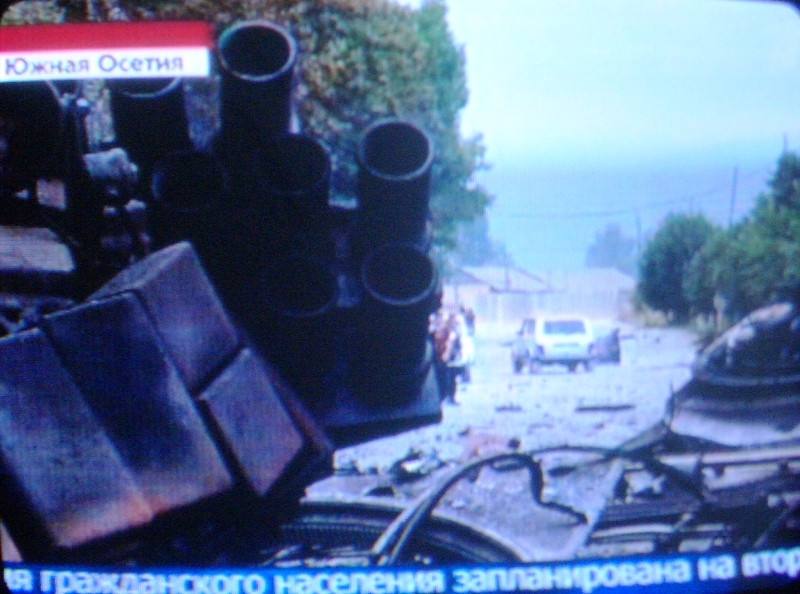
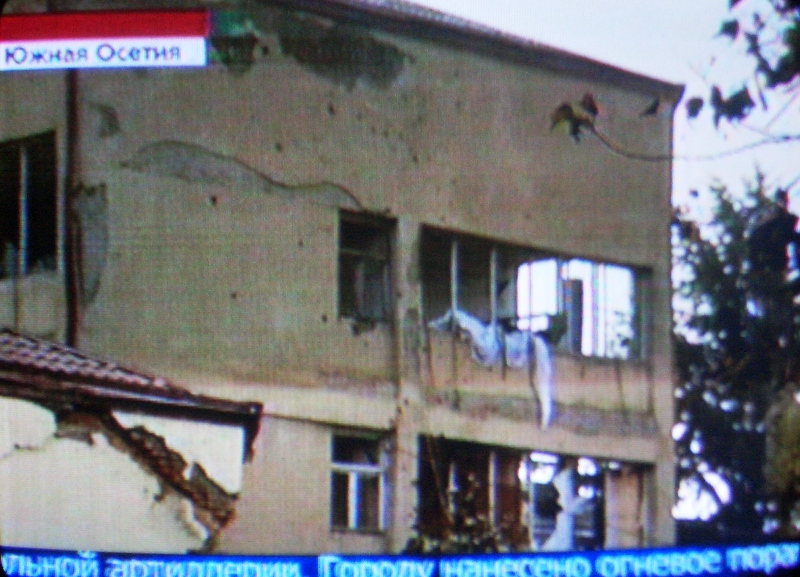
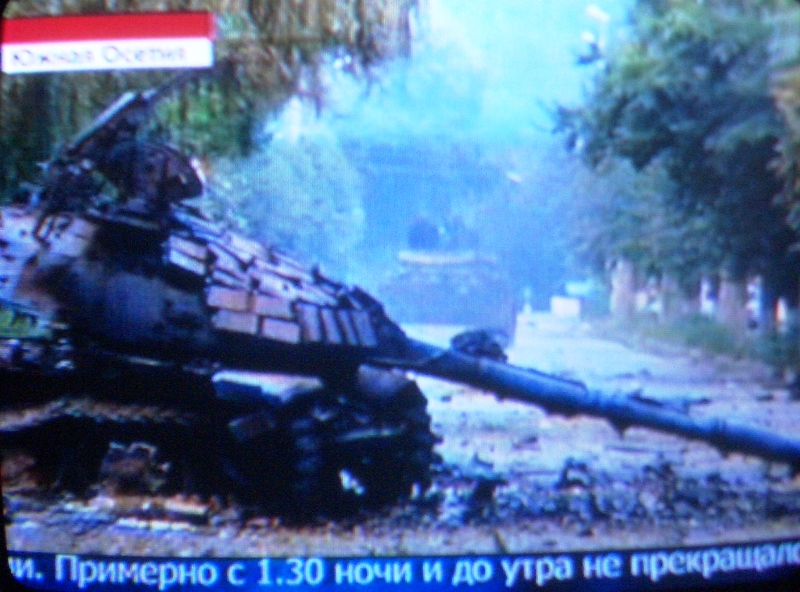
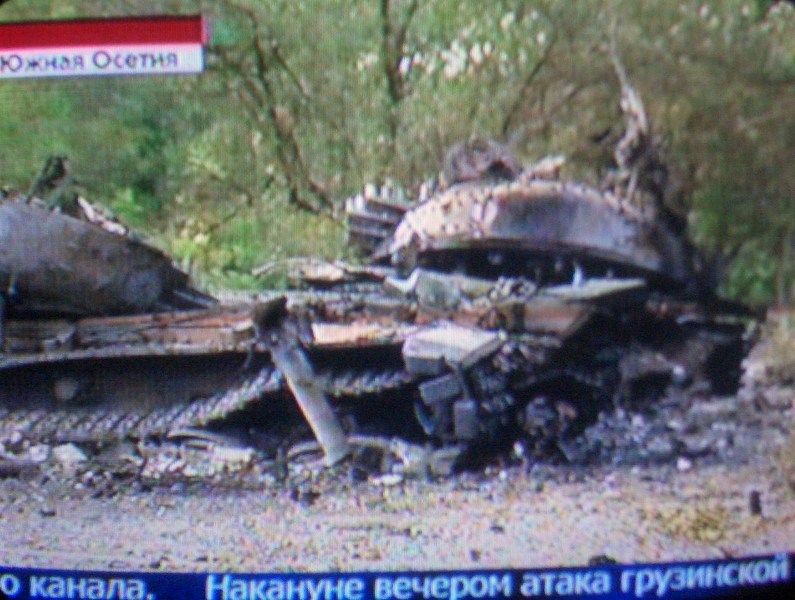
Well, it's not looking good right now in South Ossetia, a republic that Georgia and most of the rest of the world recognizes as part of Georgia, but which the South Ossetian and Russian governments consider independent. Russian troops have been stationed in South Ossetia for years, where the Russian rouble is the currency and where most people have been given Russian citizenship. Today, some of their soldiers were killed when Georgian troops attacked in an apparent effort to retake the region. Russian troops then responded in force, sending tanks across the border. I won't go into details about what is actually happening there, since the facts are in dispute and my only access to news right now is Russian television. However, I can make a few observations.
First of all, it is no small coincidence that Russian media has been comparing this conflict so frequently to the breakup of Yugoslavia. Indeed, Russia has been following a policy not unlike the policies followed by the European Union and the United States vis-a-vis Yugoslavia in the early 1990s. Russia recognizes South Ossetian independence, and for years has stationed its soldiers there as "peacekeepers." The message seems to be pretty clear: what's good for the goose is good for the gander. If the United States and Europe are able to detach Croatia, Slovenia, Bosnia, and--most recently--Kosova from Yugoslavia, then Russia can detach South Ossetia from Georgia.
Secondly, considerable bitterness towards the United States is being exhibited on television. State-run television in Russia has commented a number of times on the presence of a large number of retired American generals--many of whom, it is emphasized, had experience fighting American wars in the Balkans in the 1990s--operating as military consultants in Georgia. Russian television has also been complaining about "propaganda" in the American and British media coverage of the war, pointing out that CNN, the BBC, and other news organs have emphasized the story of Russian tanks entering South Ossetia, rather than the fact that Georgian troops had entered South Ossetia first.
Thirdly, as cloyingly patriotic and ridiculously one-sided as Russian state television has been during this crisis, what I find most depressing about listening to those hacks is the extent to which they remind me of the their American counterparts. It's one thing for stooges working in government-owned media in Russia to act this way, but what's the excuse of the American media?
Images from Russian television
I expect to see a lot of anti-Russian vitriol in the American media in the upcoming days. Indeed, I'm already seeing a lot of anti-American vitriol in the Russian media. My main hope is that the vitriol comes to an end and people can go back to their lives.
Also--maybe I've just been brainwashed by Russian media, but I don't believe that Saakashvili would have done this without an American green light. It's hard to believe that Washington could exercise such bad judgment, but I wouldn't put anything past this administration.
One thing that everyone has to keep in mind is that the United States and Russia have, for fifteen years, been fighting proxy wars for influence in the Balkans and the former Soviet Union. While in the United States we view American policies vis-a-vis the former Yugoslavia as having been undertaken in the interests of protecting human rights and national rights of self-determination, Russians tend to see American actions in this regard as cynical acts of naked aggression.
Sound familiar? If it does, it's because that's how most of the American media will no doubt portray Russian actions in South Ossetia. I'm not saying that what the Russians are doing is right--but why should Slovenian or Croatian self-determination in 1993--or Kosovar independence in 2008--be more inherently just than South Ossetian self-determination? On the other hand, if Russia is allowed to defend its national integrity in Chechnya, why can't Georgia do the same thing in South Ossetia?
There are, of course, double standards on both sides. Russia and the United States are both following what their leaders consider to be their national self-interest, and neither side has exactly cornered the market on moral international behavior. Everyone should therefore do themselves a favor by not getting carried away with their rhetoric and doing their best to work this problem out before things get out of hand.
I guess it's a good thing I haven't bought my Moscow-Tbilisi plane ticket yet.
Thursday, June 26, 3:37 pm
The other day Roger Cohen of the International Herald Tribune had a column in the NYT about Turkey. There were some things about the column that I liked, and other parts of it that I felt a little uncomfortable with. Like a lot of people who write on Turkey, Cohen describes the country as a “bridge,” and emphasizes the extent to which Islam in country does not fit in with George W. Bush’s conception of the world.
Turkey was not made for Bushworld. The polarizing labels of his Manichean global struggle — us-or-them, good-or evil, for-us-or-against-us — do not work for a nation of nuances, Muslim but not Islamist, religious in culture but secular in construct, of the Occident and the Orient, bordering the West’s cradle in Greece and its crucible in Iraq. |
The first question I have, however, is: what country is made for ‘Bushworld?’ The comments above are indeed true for Turkey—but they are also true for most Muslim (and non-Muslim) societies in the world.
Secondly, Cohen mirrors the views of a lot of Turkey observers with regard to his understanding of “secularism” in Turkey (I put ‘secularism’ in quotes, because Turkey’s form of laicism, which emphasizes state control over religious institutions, bears little resemblance to secularism as it is practiced in the United States, where the emphasis is upon a separation of state and religious institutions). Like many other people who write on Turkey, Cohen sees Turkey’s relatively (compared to most Middle Eastern countries, and indeed compared to most Muslim-majority states) high levels of social and political freedom as resulting primarily from “secularist” policies adopted during the early years of the Republic.
...the secular foundations of modern Turkey have been essential to creating this most permissive of Muslim societies; they should not be compromised without a fight, especially in a Middle Eastern environment where democracy is rare and Islamism potent. |
‘Secularism’ is, of course, along with ‘Republicanism,’ one of the two most important of the six principles of the Republic. But, in the twentieth century, many states with majority Muslim populations undertook secularist projects not unlike Turkey’s. Syria is an example. Iran is another. Egypt a third. In the Middle East and elsewhere in the “Muslim World,” ‘secularism’ (usually laicism) was hardly the exception in the twentieth century, it was quite common.
Which leads me to believe that Turkey’s laicism is not the only variable behind the country’s relative social and political freedom. There are other factors involved, one of the most important of which being Turkey’s status as the successor state to the Ottoman Empire's legacy dating back to 1300. Indeed, parliaments, political demonstrations, a largely free press, and other staples of an open political society existed in the Ottoman Empire before the creation of the Turkish Republic in 1923.
Don’t get me wrong: I’m a fan of secularism, too. However, the Turkish state’s hard line vis-à-vis the open practice of Islam should not be confused with secularism as it is practiced in this country, and nor should it be seen as the only, or even the main, reason behind Turkey’s political openness. Indeed, if anything, 'secularism' as it is practiced in Turkey has, more than once, given the country's military and bureaucracy an excuse for intervening in politics. People can disagree on whether or not Turkey's various military and bureaucratic interventions into politics have been healthy for the country or not. (Indeed, this was a topic I looked into in my Master's thesis at Princeton). However, it's an issue that deserves to be debated, rather than short-circuited or ignored.
Indeed, Cohen’s column appears against the backdrop of the latest such intervention. As I discuss in a June 6 posting, the country's constitutional court has agreed to hear a case calling for the ruling AK Party to be shut down and for dozens of AK Party members (including Abdullah Gül and Tayyıp Erdoğan, the president and prime minister) to be banned from politics for up to five years.
Cohen says that he would be against the ban, but that he wouldn’t be very sorry if it occurred.
The court should refrain from the ban. But I’m glad the threat of it exists. And if it came, I’m sure a successor to Erdogan, and perhaps the AKP, would quickly emerge. The fight for Turkey’s soul is not about to abate: it’s salutary as long as it remains open. The West should do all it can to safeguard that openness — and that may involve an occasional dose of “secular fascism.” |
So, I guess that Cohen's argument is that democracy is a good thing for Turkey, except for when it isn't. And indeed, lots of Turkish people--including most of my Turkish friends--would agree with this view. Like Cohen, they are apparently optimistic that Turkish voters who supported the AK Party and its earlier permutations will continue to be patient. I hope they're right.
Thursday, June 19, 1:43 pm
The oil companies and Iraq
An article by Andrew E. Kramer appearing on the website of the New York Times last night reports on the awarding of no-bid contracts to Exxon-Mobil, Shell, Total, BP, and Chevron.
The no-bid contracts are unusual for the industry, and the offers prevailed over others by more than 40 companies, including companies in Russia, China and India. |
While the contracts are not large, they are considered important by industry analysts for establishing position with respect to a series of lucrative new contracts which are expected to open up soon.
“The bigger prize everybody is waiting for is development of the giant new fields,” Leila Benali, an authority on Middle East oil at Cambridge Energy Research Associates, said in a telephone interview from the firm’s Paris office. The current contracts, she said, are a “foothold” in Iraq for companies striving for these longer-term deals. |
One question: since the oil companies are obviously benefiting from the American occupation of Iraq, when are they going to start paying some of the war's costs?
Something else: since the 2003 invasion, I've spent more than two and a half years abroad, mostly in Turkey, Russia, and Azerbaijan. The vast majority of people I've spoken to about the war in those countries were convinced that the principle reason behind the invasion was America's desire to seize Iraqi oil.
Call me naive, but I've always found such arguments simplistic. As tempting as it may be to see the war only in terms of a massive petro-conspiracy, it is important to look at broader contexts in the years preceding the invasion: the widespread assumption (even among people against the war) that Iraq was working on weapons of mass destruction and the increasingly militaristic and unilateralist policies of the United States (see Grenada, Libya, Iraq '91, Panama, and Yugoslavia) in previous administrations were at least as important in convincing Americans (both policymakers and otherwise) that problems could and should be solved through armed conflict. Most important of all, of course, was the enormous sense of fear that enveloped this country after 9/11. What's naive, in my opinion, is to assume that this fear did not also extend to people in the position of influencing policy.
But when it comes to taking another country's resources, I guess there's never a bad time. There may have been other reasons for invading Iraq, and for staying there, but oil is nevertheless a big part of the picture. For those who believe that oil is the entire picture, the policies of the occupation authorities and their Iraqi partners do little to complicate this narrative.
Friday, June 13, 12:59 am
End of the Exile?
It looks as if the Exile, which was once (at times) one of the funniest and most interesting expat publications anywhere, is shutting down. After eleven years of publishing in Moscow, the newspaper that mixed punk rock with political analysis is apparently on the brink of getting closed by Russian authorities. Mark Ames, the editor and founder of the Exile, has written on his tribulations in Radar (here and here), while Exile contributor (and National Bolshevik leader) Eduard Limonov has likewise posted a piece on the closing at grani.ru.
While the Exile has lately been only a shadow of its former self, it's a real shame to see the paper close down. Editors Mark Ames and Matt Taibbi did their best to prevent the paper from being taken seriously by political analyst/international relations types, but the Exile has nevertheless often been a great source of original and detailed analysis of politics in the former USSR. In particular, Ames and friends have been very good at exposing the hypcrisy and double-talk surrounding much of the American media coverage of Russia, including the Moscow-based foreign press corps.
I don't know about other folks who work on Russia but I'll miss reading the Exile, even in its current truncated form.
Tuesday, June 10, 10:50 am
More on America's proposed long-term alliance with Iraq
McClatchy is reporting that the United States is demanding fifty-eight military bases as part of a military agreement between Washington and Baghdad which would facilitate America's long-term occupation of Iraq. Currently, the United States operates about thirty major bases in the country.
The current UN mandate through which the US is occupying Iraq expires on December 31 of this year. American officials are therefore reportedly determined to conclude the alliance with Iraq by July 31, in order to allow time for parliamentary deliberations in Iraq.
No such interest in parliamentary concerns will likely emerge in the United States, however. By not officially classifying the alliance as a "treaty," the Bush administration apparently is planning on bypassing the Senate's constitutional right to review and approve any treaties between the United States and other countries.
While the proposed alliance has been roundly ignored by the major newspapers and television stations in the United States, it has elicited widespread protest in Iraq, the subject of a May 31 posting on this site.
As far as I know, Juan Cole has written more about this than anyone else in the American print/internet media.
Saturday, June 7, 1:52 am
The Bush administration is attempting to set up a long-term military alliance with Baghdad. According to Patrick Cockburn of the Independent, the alliance will include no formal treaty, so Bush will not be obliged to submit it to the Senate for approval. Cockburn also reports that, in order to convince the Iraqi government to accept the deal, Washington is holding more than fifty billion dollars of Iraq's money hostage.
Why are the media not talking about this? Is this not a newsworthy story? As Juan Cole points out in his Friday posting, widespread protests taking place last Friday across southern Iraq in opposition to this alliance were hardly reported upon at all by newspapers and television channels in the United States.
Friday, June 6, 6:08 pm
Recent events in Turkey
Turkey's Constitutional Court ruled nine to two yesterday to overturn constitutional amendments adopted by the Turkish parliament in February allowing women to wear headscarves in class at the country's universities.
The headscarf issue has been a bone of contention in Turkey for years. In the 1990s, universities were allowed to set their own rules regarding the wearing of headscarves (meaning only a scarf tied under the chin--full-length chadors have never been allowed). After the government of Necmettin Erbakan was overthrown in 1997, however, headscarves for students at universities were banned altogether under the new and more aggressive secularism embraced by the state as part of the so-called "February 28 administration."
In February of this year, the ruling AK Party of Turkey tabled a bill--which passed with the votes of 411 deputies or 80 percent of the Turkish parliament--allowing women to wear headscarves at universities.
The ruling overturning this law is hardly surprising given Turkey's current political climate. In March of this year the Constitutional Court accepted a case filed by the country's top prosecutor asking that the AK party be closed and that seventy-one party members--including President Abdullah Gül and Prime Minister Tayyıp Erdoğan--be banned from politics for a period of five years. A decision on the closure of the AK Party and the exclusion from politics of the seventy-one members is expected later this year, probably in the early Fall.